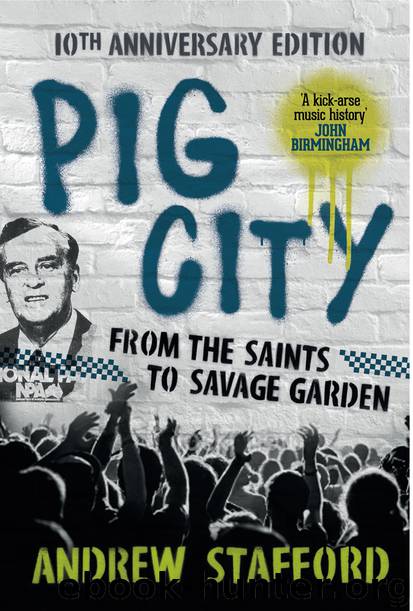
Pig City by Andrew Stafford
Author:Andrew Stafford
Language: eng
Format: epub
Publisher: University of Queensland Press
Published: 2014-05-27T04:00:00+00:00
While the rest of Queensland emerged from its long slumber, students at the University of Queensland, the traditional hotbed of political agitation, had fallen asleep at the wheel.
Triple Zed was in serious decay, so poor it had been forced to cancel the local newspaper delivery. The station was hit on several fronts: as venues and gig promotions around town dwindled, so too the station’s lifeblood of subscriptions began to dry up. With the station relying on a core group of mostly inexperienced volunteers, it became harder to turn the broadcaster’s fortunes around. David Lennon was one forced to sink or swim.
David Lennon: That last six months before the eviction, there were only a very small handful of us running the station. The main core of staff before then just floated off and never came back, basically.
For more than a decade Triple Zed’s sheer necessity had been enough to justify its existence, and for much of that time the station had repaid its listeners with much more besides. But by 1988, with economic rationalism in the ascendant and the state government on the skids, selling the ‘warm inner glow’ of being part of the station was no longer going to be enough. Triple Zed’s great mistake was of the kind so common to the left: it took its righteousness for granted. While this was understandable in the face of Bjelke-Petersen, it meant that when the inevitable challenge arrived, the station was thoroughly unprepared.
David Lennon: Andy Nehl came up with the idea of the warm inner glow at a radiothon in 1986 and I think that line was used as a cliché ever since. We used to be able to say give us money because we need it and we’re on your side, but it doesn’t work now. You have to show that you’re giving people value for money.
Jim Beatson: There’s a great episode of The Simpsons about community television, where it just shows one person in a room, begging people to give him money. Well, people give money because they like something; they don’t give money because somebody’s jangling a tin.
Triple Zed had another crucial benefactor underwriting its survival: the student union. The close links between the union and station founders in 1975 had resulted in a start-up loan (never expected to be repaid) of $250,000, while the station paid a peppercorn rent of $2 per month for its use of the premises. Ongoing administrative costs were funded by the union too: around $17,000 per year. The dominance of the left in student politics had kept the arrangement cosy long after the union ceased to have any effective representation or influence on the station’s direction.
The first shot across the bows came in March 1988, when a union council meeting refused to approve the station’s quarterly administrative budget. The response was immediate, with hundreds of station supporters picketing the union building in response. But the union president of that year, Dirk Moses, had fingered the station’s weak link: Triple Zed had no formal links to the student body, and its right to ongoing student funds was dubious at best.
Download
This site does not store any files on its server. We only index and link to content provided by other sites. Please contact the content providers to delete copyright contents if any and email us, we'll remove relevant links or contents immediately.
| Anthropology | Archaeology |
| Philosophy | Politics & Government |
| Social Sciences | Sociology |
| Women's Studies |
The Secret History by Donna Tartt(19103)
The Social Justice Warrior Handbook by Lisa De Pasquale(12197)
Thirteen Reasons Why by Jay Asher(8919)
This Is How You Lose Her by Junot Diaz(6894)
Weapons of Math Destruction by Cathy O'Neil(6285)
Zero to One by Peter Thiel(5808)
Beartown by Fredrik Backman(5768)
The Myth of the Strong Leader by Archie Brown(5513)
The Fire Next Time by James Baldwin(5454)
How Democracies Die by Steven Levitsky & Daniel Ziblatt(5225)
Promise Me, Dad by Joe Biden(5157)
Stone's Rules by Roger Stone(5091)
A Higher Loyalty: Truth, Lies, and Leadership by James Comey(4967)
100 Deadly Skills by Clint Emerson(4932)
Rise and Kill First by Ronen Bergman(4797)
Secrecy World by Jake Bernstein(4756)
The David Icke Guide to the Global Conspiracy (and how to end it) by David Icke(4724)
The Farm by Tom Rob Smith(4517)
The Doomsday Machine by Daniel Ellsberg(4493)
